
# Introduction: Why Are We So Obsessed with "Choice"?

In the vast intellectual landscape of human civilization, perhaps no question has been as intuitively natural, yet as spine-chilling upon deeper examination, as "free will."
Pause for a moment and feel it. When you decided to click on this in-depth article, instead of scrolling past to an endless stream of short videos, you were convinced it was "your own" decision, right? You clearly feel that you are in the driver's seat of "self," hands firmly gripping the steering wheel of life, foot on the accelerator, choosing this particular path from countless possible forks in the road. This intuition of "I am in control" is so deeply ingrained that it forms the cornerstone of our moral responsibility, legal punishment, and even our dignity as independent individuals. After all, if you didn't choose your actions, what meaning would there be in praising your achievements or punishing your crimes?
However, is this merely an elaborate illusion evolved to allow us to live in peace?
Let's zoom out and examine the world from a physicist's perspective. If Newton was right, the universe, from the moment of the Big Bang, has been like the first domino falling, with everything that followed—the collapse of stars, the orbits of planets, the flow of wind—being nothing but a chain reaction strictly governed by physical laws. Your brain, touted as the most complex object in the universe, is ultimately composed of atoms and electrons. If the trajectory of every atom was predetermined by physical laws ten billion years ago, then every thought that flashes through your mind, every emotion that stirs in your heart, and even the slightest eye movement as you read this sentence, were they not also already written into that unchangeable cosmic script?
This is the most terrifying core of the free will problem: Are we merely predetermined cogs in the universe's precise and cold machine, or are we true creators with the ability to rewrite the script?
The discussion of free will is by no means a dry academic exercise for philosophers in ivory towers; it is a brutal long-distance race towards the truth of human existence. From the ancient Greeks' fear of the goddesses of fate when they gazed at the stars, to medieval theologians' arduous defense in the shadow of God's omniscience and omnipotence; from Enlightenment thinkers seeking cracks in the mechanical universe, to modern neuroscientists observing brain signals preceding consciousness in MRI machines—for two and a half millennia, we have been trying to answer the same soul-searching question.
This is not just a philosophical proposition; it concerns how we define "human." If we have no free will, could Nazi war criminals at the Nuremberg trials argue that they were merely puppets of "necessity," and thus innocent? If we do possess free will, how does it carve out a place for itself in the airtight walls of deterministic physical laws?
Today, this report will take you on a millennia-spanning intellectual adventure. We will peel back the surface, follow the historical脉络, and witness how human wisdom has repeatedly attempted to break through the walls of "destiny." This is not a simple, linearly ascending evolutionary process, but a series of ideological storms that have repeatedly started anew. We will see how theology, science, and philosophy, in intense crossfire, have pushed our understanding of freedom towards the deeper Real (The Real).
Are you ready? Let's go back to where it all began—the dawn when gods still looked down from the clouds, intervening in mortal fates.
# Part One: The Dawn's Dilemma (Ancient Greece)
When we try to trace the origins of free will, we find that the ancient Greeks did not initially possess a clear concept of "will." In the Homeric age, a time of heroes, Achilles' rage or Odysseus's wanderings were often seen as the results of gods manipulating mortals like puppets. However, with the rise of city-state civilization and the birth of legal systems, a core contradiction emerged: If everything is determined by gods or fate, what is the legitimacy of punishing criminals in court?
# 1. Plato's Chariot of the Soul: The Eternal Tug-of-War Between Reason and Desire

In Phaedrus, Plato used a brilliant and timeless metaphor, the "Chariot Allegory," to sketch the earliest blueprint for human inner freedom and conflict [1].
Try to imagine a two-horse chariot racing across the sky, with a charioteer struggling to control it:
- The Charioteer (Reason): He represents our intellect, judgment, and self-control. His goal is to drive the chariot through the clouds, flying towards the "heavenly realm" of truth and beauty.
- The White Horse (Spirit): This is a noble steed of pure lineage, representing honor, courage, and other noble passions. It is obedient and compliant, a powerful assistant to the charioteer.
- The Black Horse (Appetite): This is a wild, unruly beast, not only ugly but also savage. It represents carnal instincts, greed, and endless cravings, constantly trying to drag the chariot down to earth, into the mire of sensory pleasures.
Plato profoundly observed that: Freedom is not doing whatever one pleases, but the conquest of desire by reason. If the charioteer is dragged by the black horse, and the chariot loses control and falls, the person may seem to be pursuing pleasure, but is actually enslaved by desire. Only when the charioteer (reason), with the assistance of the white horse, successfully tames the black horse, making both horses gallop in unison towards the goal, does the soul achieve true freedom. This view of "reason's sovereignty" laid the foundation for two millennia of Western thought—freedom is doing what you "truly" want to do, not what you "impulsively" want to do.
# 2. Aristotle: The Origin of Action Lies Within Us
If Plato built a model of the soul in the heavens, Aristotle established the laws of responsibility on the ground. In Nicomachean Ethics, this great classifier acutely pointed out that the premise of law and morality is "voluntary" [2].
Aristotle proposed a standard of judgment that remains legally valid today: Where does the origin (Arche) of an action lie?
- If the origin is external—for example, a strong wind blows you over, causing you to bump into a passerby—then your action is involuntary, and you are naturally not responsible.
- If the origin is internal—you know what you are doing and are not being forced—then your action is voluntary, and you must bear the consequences.
But here's a tricky rebuttal: "If a person has a bad character and cannot control themselves from doing evil, just as a lame person cannot control their limping walk, are they still responsible?"
Aristotle offered a powerful counter-argument: Character itself is the result of countless voluntary choices we have made in the past. He used a vivid analogy: just as once you throw a stone, you can no longer control its trajectory; but before you threw it, whether to throw it and where to throw it was entirely within your control. Our character is that thrown stone, which we have collectively forged through daily habits. Therefore, we are not only responsible for our present actions but also for "becoming the kind of person we are."
# 3. Stoicism: Free Because Bound

As the glorious classical era ended, the Hellenistic age brought with it the collapse of city-states and a sense of individual insignificance. Stoicism faced a deterministic universe strictly set by Rational God (Logos). In such a pre-scripted stage, did actors still have room for improvisation?
Chrysippus explained this with a "cylinder analogy" [3]: When you push a cylinder, it rolls. The push is an external cause, but whether it "rolls" rather than "slides" or "falls over" depends on its own cylindrical shape (internal nature). Similarly, fate gives us external stimuli, but how we respond depends on our inner constitution.
The Stoics left a more brutal yet wiser analogy, vividly depicting the nascent form of this "compatibilism": We are like a dog tied to a moving chariot.
- The chariot (fate) is moving forward. If the dog runs in the direction of the chariot, it can not only keep pace but also enjoy the scenery along the way; in this state, it is free.
- If the dog resists and refuses to move, it will eventually be dragged by the chariot, not only getting bruised and battered but also losing its dignity.
Here, freedom is no longer about changing fate (the chariot's trajectory) but about adjusting our cognition (Assent) to reconcile with fate. As the Roman philosopher Seneca said: "The willing are led by fate, the unwilling are dragged." This is an inward freedom, the ability of the mind to maintain a noble posture in the face of necessity.
# Part Two: The Game Between Theology and Freedom (Middle Ages)
When the glory of the Roman Empire faded under the barbarian hooves, Christian theology took up the torch of civilization. The battlefield of free will shifted from the city-state square to the metaphysical heights. This time, humanity's opponent was no longer cold, blind fate, but the omniscient and omnipotent God. If God foreknows everything, and even predestines everything, how can humans be free? If humans are not free, is God's judgment of our sins just?
# 1. Augustine and the Origin of Evil: The "Absence" of Will
If God is supremely good, and God created all things in the universe, then "evil"—where does it come from? This was the biggest dilemma confronting medieval theologians. Augustine offered a surprising and profound answer: Evil is not a created entity, but a privation of good.
In On Free Choice of the Will, Augustine pointed out that God endowed humanity with free will, which is God's greatest gift and greatest good. For without freedom, there is no true love, no true morality [4]. The obedience of a robot is worthless; only love chosen freely is precious.
However, the double-edged nature of freedom is that we can choose to ascend to the eternal God or descend to earthly pleasures. When the will deviates from the immutable good and turns towards the mutable nothingness, "evil" is born. This is like darkness not being a "substance," but merely the absence of light; coldness not being a form of energy, but the lack of heat. Similarly, evil is merely a "wrong turn" or "absence" of the will.
Augustine's brilliant defense, while logically clearing God of suspicion for creating evil, placed a heavy cross on humanity: We are solely responsible for our own fall. It is because we misused this freedom that original sin resulted. In his later work, The City of God, facing the universal sinfulness of humanity, Augustine became more pessimistic, believing that after Adam's fall, human will was paralyzed, and only through God's grace could these broken legs stand again.
# 2. Aquinas's Precision Clock: The Dance of Intellect and Will
Centuries later, Thomas Aquinas, the great synthesizer of Scholastic philosophy, built an even grander and more rigorous rational edifice upon Aristotle's foundations. He refused to see the will as a blind impulse, proposing the famous proposition: "The will is a rational appetite."
Aquinas meticulously dissected the complex interactive mechanism between intellect and will, like disassembling a precise pocket watch to reveal the process of choice [5]:
- Intellect Precedes: The intellect acts like a spotlight, surveying the surroundings and showing the will what is "good" (e.g., health is good, knowledge is good).
- Will Drives: The will acts like an engine; it not only desires that goal but also pushes the intellect to find means to achieve it (e.g., for health, should I exercise or diet?).
- Circular Interaction: The two are not a one-way command but are intertwined, mutually propelling each other.
Aquinas believed that our pursuit of "ultimate happiness" (Universal Good) is necessary and not chosen by us, just as a magnet necessarily points north due to its magnetic property, humans necessarily desire happiness. However, regarding the specific means to achieve happiness—whether to drink this wine or read that book; whether to live a monastic life or engage in commerce—the intellect provides multiple options, and no single option has compulsory attraction, thus the will possesses the freedom to choose.
The foundation of freedom lies in our ability to examine our own judgments. Animals see food and eat it because they cannot step back and examine the impulse of "hunger"; humans, however, can step back and ask themselves: "I want to eat, but is this good for me?" It is this reflective gap that accommodates free will. This exquisite balance reached its peak in the late Middle Ages, but with the approaching footsteps of the Scientific Revolution, this rational edifice was about to face its most violent冲击.
# Part Three: The Ghost in the Machine (Modern Enlightenment)
As the clock turned to the 17th century, Galileo's telescope and Newton's equations transformed the universe into a vast, precisely running machine. In the inevitability of interlocking gears, every event was the necessary result of a previous one, and human free will seemed like a superfluous part. Philosophers were forced to seek a new ceasefire line between science and freedom, and this breakout battle was exceptionally fierce.
# 1. Descartes' Pineal Gland: The Ghost in the Machine

René Descartes adopted a "divide and conquer" strategy. He had to admit that our body was entirely an automatic machine driven by hydraulics, with blood surging like water in pipes and muscles operating like springs, all strictly obeying physical laws. But he steadfastly maintained that the mind was a non-material, absolutely free entity, not governed by physical laws.
To explain how these two distinct worlds—the inert material body and the free immaterial mind—communicated, Descartes found a mysterious point of convergence in anatomy: the pineal gland. He envisioned the soul as a tiny driver, sitting in the pineal gland deep within the brain, controlling the flow of "animal spirits" to operate the body machine [6].
This is the famous "mind-body dualism." Although the "ghost in the machine" theory seems somewhat clumsy and even sci-fi-like today, it successfully preserved space for scientific study of the body while locking free will into the mind's robust sanctuary, temporarily preventing its engulfment by physics.
# 2. Spinoza's Cold Scorn: The Thinking Stone
Baruch Spinoza scoffed at Descartes' "muddling through" compromise. He threw out one of the most terrifying thought experiments in philosophical history: throwing a stone.
Spinoza said, imagine a stone thrown into the air, flying. If this stone suddenly gained consciousness, it would surely believe it "decided itself" to fly there, completely ignoring the hand that threw it and the force of gravity behind it. Humans are this stone. We think we are free simply because we are "conscious of our desires, but ignorant of the causes that determine them" [7].
In his view, freedom is not at all what ordinary people understand as "doing whatever one pleases"—that is merely an ignorant expression of being enslaved by emotions. True freedom is "the understanding of necessity." This is akin to a mathematician who is not "free" to invent formulas, but gains spiritual liberation by understanding the necessary laws of geometry. A truly free person is one who uses reason to discern that all things are necessarily so, thereby no longer being tormented by fear and hope, and actively conforming to the laws of nature. This is a cold, almost divine, kind of freedom.
# 3. Hume's Pragmatic Rescue: The Maturation of Compatibilism
David Hume neither stubbornly defended the soul like Descartes nor radically embraced fate like Spinoza. He acted like an astute mediator, proposing modern "compatibilism."
Hume acutely pointed out that our definition of "freedom" was deeply flawed. Freedom does not mean "indeterminism"—that would be the random behavior of a madman, completely unpredictable. Freedom merely means "acting according to my will." As long as no one is holding a gun to your head, as long as your actions follow your desires, you are free [8].
As for whether your desires themselves are determined by prior causes? Hume believed this was irrelevant. What matters is that we can, on a societal level, assign responsibility based on this. By "demoting" freedom to a social function, Hume cleverly bypassed the metaphysical deadlock, allowing free will to find a place in a deterministic world.
# 4. Kant's Ultimate Fortress: The Thing-in-Itself

Immanuel Kant sought to establish the last line of defense for freedom. To save morality, he had to divide the world into two:
- Phenomenal World (Phenomena): This is the realm of scientific study, the world accessible to our senses. Here, everything is strictly governed by causality; there is no freedom.
- Noumenal World (Noumena / Thing-in-itself): This is the world as it is in itself, transcending space, time, and causality, a realm we can never know.
Kant believed that humans, as biological beings, belong to the phenomenal world and are subject to physical laws; but humans, as moral subjects, belong to the noumenal world and possess transcendental freedom. If we are not free in the noumenal world, then moral imperatives ("you ought to do something") would be meaningless—because "ought" implies "can." While Kant admitted that we can never scientifically "prove" freedom, he insisted that we must "postulate" ourselves as free, otherwise human dignity would be utterly lost [9].
# Part Four: God is Dead, Man is Free (Modern Existentialism)
When Nietzsche's famous roar—"God is dead"—echoed across Europe at the end of the 19th century, he simultaneously blew up humanity's protective umbrella. Without an omnipotent God and absolute moral laws, all that remained was naked freedom. Philosophy during this period was no longer concerned with proving the existence of freedom, but with how to bear its heavy burden.
# 1. Nietzsche's Übermensch: Freedom is the Will to Power

Friedrich Nietzsche shattered the traditional concept of free will with a hammer. He despised the weak who yearned to be "saved," believing that traditional "free will" was merely a lie concocted by priests to make the strong feel guilty and the slaves feel equal.
In his view, true freedom belongs to the "Übermensch" (Superman). The Übermensch accepts no externally imposed values—neither religious precepts nor social customs—he creates his own values. For Nietzsche, freedom is not a comfortable static state, but a dynamic eruption of "Will to Power" [10].
This kind of freedom demands that you must be like a cold sculptor, holding a sharp blade, brutally cutting away the weak, conformist parts of yourself, and sculpting yourself into a unique work of art. As Zarathustra said, this is a painful yet supremely magnificent freedom that only the strongest souls can wield.
# 2. Sartre's Verdict: Condemned to Be Free

Jean-Paul Sartre pushed this freedom to a suffocating extreme. He proposed the famous proposition: "Existence precedes essence."
What does this mean? Imagine a pair of scissors; before a craftsman makes it, he already has the "concept of scissors" in mind (its essence is to cut paper). So for scissors, essence precedes existence. But humans are different. Humans first come into this world, encounter this world, and then define themselves through their own actions. We have no preset script, no God-given mission.
Therefore, Sartre uttered a deafening statement: "Man is condemned to be free." [11].
Note his choice of words—"condemned." This is not a gift, but a sentence. If you are a waiter, you might behave extremely like a waiter, with standard movements and a beaming smile. Sartre calls this "bad faith." Because you are trying to treat this as your essence, thereby escaping the burden of choice. But in fact, every moment you are choosing to play this role. You cannot say, "I have a bad temper because I was born this way"; that is just a coward's excuse. The fact that you are angry with him at this moment means you chose to be angry.
We bear absolute responsibility, with nowhere to escape, nothing to shirk. With every choice we make, we set an example for all humanity. This freedom brings not easy joy, but profound anguish. We stand alone on the cliff of nothingness and must take a step, and that step will determine who we are.
# Part Five: The Judgment of Science (Contemporary Challenges)
In the 20th century, the laboratory doors opened. Scientists, armed with scalpels, EEGs, and quantum equations, entered the courtroom. They told philosophers, "You've been arguing for two millennia; now let's look at the evidence." This round of judgment seemed poised to push free will to the brink.
# 1. Laplace's Demon: The Terrifying Gaze of the Omniscient
Pierre-Simon Laplace conceived of a ultimate nightmare in physics, known as "Laplace's Demon."
Imagine a demon of infinite intellect, knowing the precise position and momentum of every atom in the universe at this very instant, and possessing infinite computational power to process this data. According to Newtonian mechanics, it could then calculate the state of the universe for every second of the future with a single equation [12].
In this model, the moment the Big Bang occurred, the universe's causal chain was already laid out like dominoes. What you had for breakfast today, how many times you blinked while reading this sentence, was all predetermined thirteen billion years ago. If the brain is merely a collection of atoms, and atoms strictly obey physical laws, then isn't "choice" simply the inevitable result of atomic collisions? Our supposed freedom might just be like a falling stone thinking it's flying.

# 2. Libet Experiment: Consciousness a Half-Second Late
If Laplace's Demon was merely a theoretical scare, then Benjamin Libet's 1983 experiment delivered the heaviest blow to free will.
He designed a simple experiment: participants stared at a rapidly rotating clock, decided to move a finger at any moment, and noted the exact time they "intended to move." Simultaneously, an electroencephalogram (EEG) monitored the participants' brain activity.
The results were astonishing: 0.5 seconds before participants became aware of their "intention to move," a distinct electrical signal, called the readiness potential, had already appeared in the brain's motor cortex [13].
What does this mean? Your brain had already made the decision before you knew you were going to make it. Was "free will" merely hindsight? Like a puppeteer (the subconscious brain) pulling the strings, while the puppet (conscious mind) smugly says, "I wanted to dance myself." Although Libet later argued that consciousness might have a "veto power" (Free Won't), able to stop the action at the last moment, this finding still kept countless believers in free will awake at night.

# 3. Quantum Mechanics: The Uncertain Lifeline?
Facing the suffocating feeling of determinism, many placed their hopes in another major discovery of 20th-century physics—quantum mechanics. Heisenberg's uncertainty principle tells us that the movement of microscopic particles contains fundamental randomness and cannot be precisely predicted [14].
Does this mean free will hides in the quantum crevices of neurons? Unfortunately, this might be a beautiful misunderstanding.
Think carefully: Does randomness truly equal freedom? If your actions are determined by quantum randomness, you're like a madman making decisions with a pair of dice. Roll a 6, you go left; roll a 1, you go right. This is indeed unpredictable, but is it called "freedom"? This is more like another form of enslavement—enslavement to chaos. The freedom we want is "I can control," not "complete randomness." It seems quantum mechanics cannot directly rescue us from the prison of causality.
# Part Six: Contemporary Echoes (Žižek and Dennett)
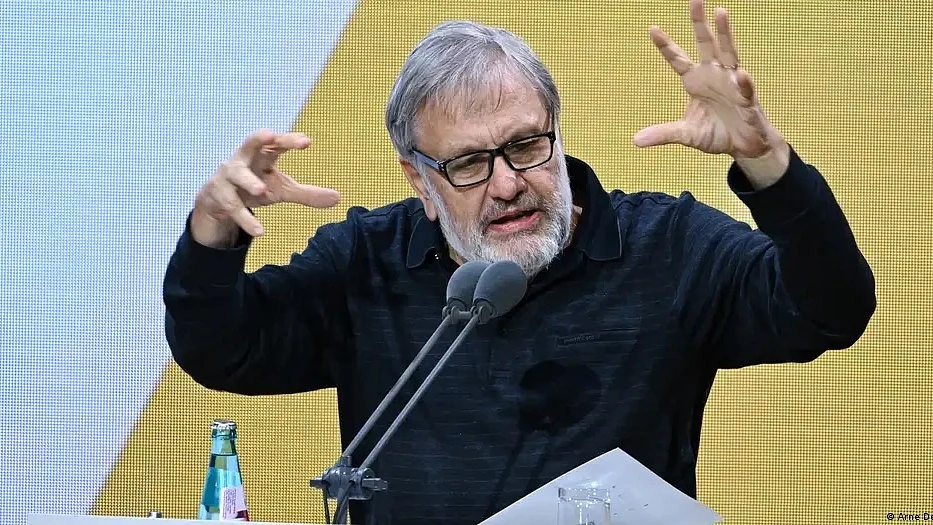
In an age when science seems poised to declare free will dead, two distinct contemporary philosophers—Slavoj Žižek, dubbed the "Elvis of philosophy," and Daniel Dennett, a staunch defender of evolution—open up entirely new perspectives for us. They no longer dwell on whether "atoms determine the brain," but shift their focus to psychoanalysis and evolutionary biology.
# 1. Žižek: Ideology and "Forced Freedom"
Žižek, with Lacan's psychoanalytic scalpel, precisely cut open the hypocritical surface of modern free will. He first shows us that our proud daily choices are often merely a carefully designed "forced choice."
(1) The Big Other's Compulsive Choice Žižek gives a classic example: when parents tell a child, "You can go to Grandma's house, or you can not go, but you should know Grandma loves you very much, and she'll be sad if you don't go." This seems like a free choice; the child has the option to "go" or "not go." But in reality, the symbolic order—what Lacan calls the "Big Other"—has already locked down the answer. If the child actually chooses "not to go," they will not only be punished but will also feel a sense of guilt for breaking some unspoken contract. The child must "freely" choose to go to Grandma's house [15].
Žižek points out that the most cunning aspect of modern ideology is not to force you to do something, but to make you feel that you want to do it yourself. We "freely" sell our labor, "freely" pursue the pleasures of consumerism. This freedom is merely the freedom to choose whether to sleep on the left or right bunk in prison.
(2) The Terrifying Act of the Real So, does true freedom exist? For Žižek, true freedom is traumatic; it carries a terrifying quality. It occurs when we tear up the script of the "Big Other" and confront the abyss of "The Real."
He often quotes Bartleby's famous line from Melville's novel: "I would prefer not to." This is not just refusing an option, but refusing to choose within the given framework of options. True free will (The Act) is an intervention that can retroactively change the past.
Does this sound abstruse? Imagine a couple breaking up. At the moment of the breakup (Act), the past three years of sweet memories suddenly change their meaning—they transform from "happy prelude" to "false lies." When we perform a radical act, we not only change the future but even rewrite the meaning of the causal chain that led to this action [16]. In this Parallax View, freedom is a short circuit of necessity.
# 2. Dennett: The Gift of Evolution and "Intuition Pumps"
In contrast to Žižek's radicalism, Daniel Dennett, like a patient engineer, attempts to repair free will within Darwin's world. He doesn't need "retroactive intervention"; he just needs evolutionary theory.
(1) Disassembling "Intuition Pumps" Dennett first warns us to be wary of "Intuition Pumps"—those bad metaphors that mislead our thinking. For example, "the terrifying neurosurgeon" or "Laplace's Demon." We often worry about being controlled by causality, as if manipulated by an invisible entity. But Dennett points out that this is a huge logical trap: Causality is not a person; it has no intentions and is not targeting you [17]. Being determined by natural laws and being controlled by a villain are two different things.
(2) Freedom as an Evolutionary Capacity Dennett proposes a core idea: Free will is not magic, but an evolved capacity. Imagine a stone and a bird. If you throw something at them, the stone cannot dodge because it is completely "deadly" determined by physical laws. But the bird will fly away. Why? Because the bird possesses "Evitability."
As evolution becomes more complex, biological brains become increasingly adept at predicting the future and avoiding risks. Humans can not only dodge flying stones but also foresee future crises (like climate change), weigh complex consequences, and respond to various reasons. This "responsiveness to reasons" is the true nature of free will. It doesn't need to violate physical laws; just as computer software runs on hardware, our freedom runs on deterministic neurons.
(3) The Kind of Free Will Worth Wanting In his seminal work Elbow Room, Dennett concludes: We may not have that "absolutely severing the causal chain" God-like freedom—the freedom to fly if we wish, or to become light if we wish. But that kind of freedom is neither possible nor important.
What we possess is "the kind of free will worth wanting" [18]. This is a capacity sufficient for us to bear moral responsibility, plan long-term lives, and exist as rational agents within a social contract. This is enough; this is already the most expensive gift evolution has given us.

# Conclusion: Dancing on the Cliff of Necessity
As we complete this journey spanning two and a half millennia, we might find ourselves back where we started, but with a completely different map in hand.
We began with the ancient Greeks' fear of oracles, passed through the mists of medieval theology, witnessed the precise gears of Newton's universe, and finally stood under the microscope of quantum mechanics and neuroscience. Each time, when science attempted to trap us with the chains of "determinism," human wisdom always managed to carve out new spaces for freedom in the crevices.
So, back to the original question: Does free will truly exist?
If you are asking about that "absolute ghost, uninfluenced by any prior cause"—that little person, like God, sitting on the brain's throne, able to arbitrarily sever the causal chain—then science coldly tells us: It probably does not exist. That little person is merely a user interface generated by our brain to integrate information.
But if you are asking: Do we possess the ability to change our own destiny, bear moral responsibility, and create meaning? Then Žižek and Dennett would tell you in unison: Yes, it not only exists, but it is more complex and precious than we imagine.
Freedom is not an innate magic, but an achievement. It is not something ready-made from birth, but a light of reason ignited in the long night of evolution, a gap of truth torn open in the encirclement of ideology. It is fragile, easily hijacked by passion, easily manipulated by environment, but it truly exists in every deliberate refusal, every altruistic act overcoming instinct, every profound understanding of "necessity."
Just as Sisyphus in Camus's writings, although gravity (physical laws) dictated that the stone must roll down, at the moment he made it his own business,

his consciousness transcended the weight of the stone. We dance on the cliff of necessity; although our shackles are never removed, the dance steps are determined by us.
This journey towards truth has no end. As long as we continue to ask, "Am I free?", this very questioning is the most conclusive proof of free will.
# References
[1] Plato, Phaedrus. [https://www.theculturium.com/plato-phaedrus-charioteer/] [2] Aristotle, Nicomachean Ethics. [https://plato.stanford.edu/entries/freewill/] [3] Stoicism. [https://plato.stanford.edu/entries/stoicism/] [4] Augustine, On Free Choice of the Will. [https://plato.stanford.edu/archives/fall2015/entries/augustine/] [5] Aquinas, Summa Theologica. [https://www.newadvent.org/summa/1083.htm] [6] Descartes, Treatise on Man. [https://plato.stanford.edu/entries/pineal-gland/] [7] Spinoza, Ethics. [https://iep.utm.edu/spinoza-free-will-determinism/] [8] Hume, An Enquiry Concerning Human Understanding. [https://plato.stanford.edu/archives/fall2018/entries/hume-freewill/] [9] Kant, Critique of Practical Reason. [https://plato.stanford.edu/entries/kant-moral/] [10] Nietzsche, The Will to Power. [https://plato.stanford.edu/entries/nietzsche-moral-political/] [11] Sartre, Being and Nothingness. [https://plato.stanford.edu/entries/sartre/] [12] Laplace, A Philosophical Essay on Probabilities. [https://plato.stanford.edu/entries/determinism-causal/] [13] Libet Experiment. [https://www.scientificamerican.com/blog/observations/how-a-flawed-experiment-proved-that-free-will-doesnt-exist/] [14] Quantum Physics & Free Will. [https://crackingthenutshell.org/quantum-physics-free-will-bell-theorem-determinism-causality-locality-realism/] [15] Zizek, The Sublime Object of Ideology. [https://thedangerousmaybe.medium.com/commentary-on-%C5%BEi%C5%BEeks-the-sublime-object-of-ideology-chapter-1-437a93debd86] [16] Zizek, Quantum History. [https://iai.tv/articles/slavoj-zizek-on-quantum-history-and-the-end-of-the-past-auid-3437] [17] Dennett, Intuition Pumps. [https://ase.tufts.edu/cogstud/dennett/] [18] Dennett, Elbow Room. [https://www.informationphilosopher.com/solutions/philosophers/dennett/]